
Kawu Musa Idris-Idah, 10th February 2025
There is a rising trend of “9 am – 5 pm” full-timers developing “side-hustles”.
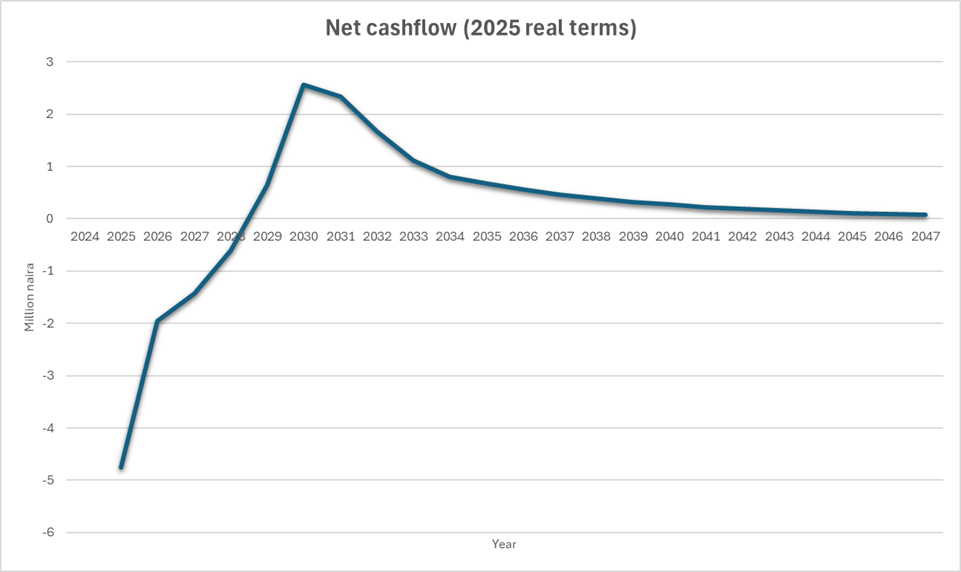
In this piece, I summarize the discounted cash flow analysis results of a “solar side-hustle”: perhaps, there are lessons for other full-timers. The underlying logic is transferable across other sectors. Assumptions, albeit being called “assumptions”, are conservatively guided by field research and realities.
Executive summary
- Doubling the annualized number of installations (whilst maintaining the same cost base) in early years triples the NPV and increases the IRR to 47% – strong emphasis on marketing in annual cost budgets. Payout period reduces to 4 years (2029).
- Reducing average annual CAPEX installations (whilst maintaining the same OPEX base) over company life to N 1,000,000, triples NPV and increases IRR to about 39%. Lesser impact in comparison to doubling annualized number of installations.
- Doubling annual OPEX (whilst maintaining the same CAPEX base) over company life decreases NPV by about 500 %. You don’t want to know the IRR.
Key economic indicators
| Net present value | ~ 4,000,000 (Naira) |
| Internal rate of return | 26% |
| Payout period | 9 years, 2034 |
Assumptions
| Company life | 25 years |
| Peak annualized number of installations | 36 installations (3 every month), from 2031 |
| Average size of installations | 5 kVA inverter systems |
| Discount rate | 20 % |
| Revenue trend | 100% annual growth rate from 2025 – 2030. 13% between 2030 and 2031. Remains constant onwards. |
| OPEX trend | 15% annual growth from 2027 – 2033. Remains constant onwards. Varies between 2 million naira and 5 million naira annually (real terms, 2025) |
| CAPEX trend | Varies between 3 million naira and 4 million naira annually (real terms, 2025) |
| Source of funding | Founder equity only |
| Taxes | Linear assumption of 10% tax rate over company life |
| Profit | Assumed figure results in positive NPV. Would vary according to installation quality. |